The Camping Cup HolderBy Steadi Labs

A base for made camp

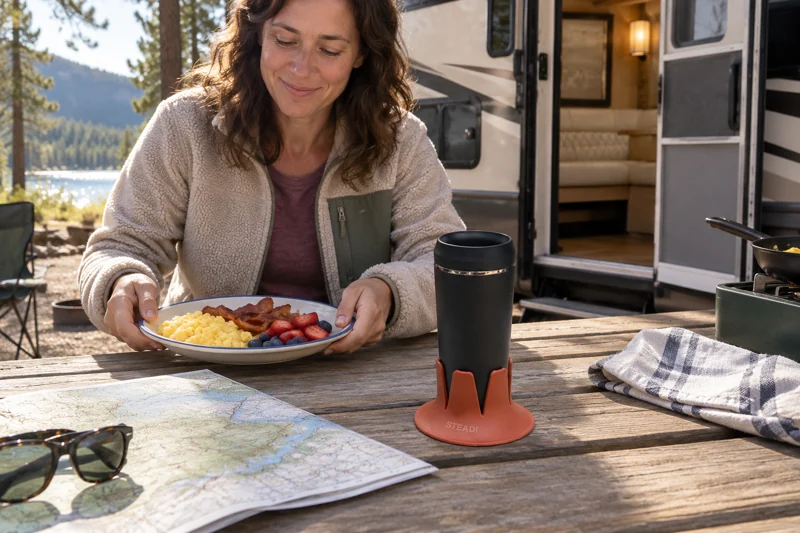
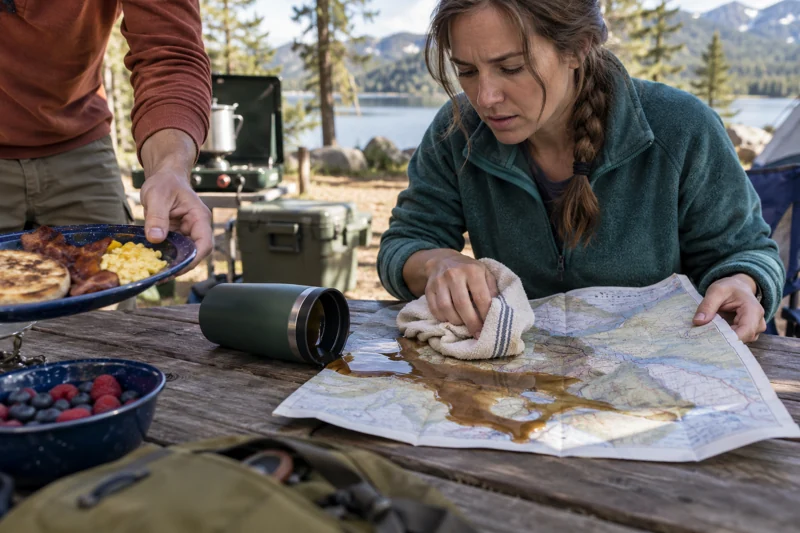
Your camp chair has a cup holder. Your campsite doesn’t.

The chair is not the villain here. VEVOR publishes a 3.9 in hole on its heavy-duty quad, wide enough for a 40 oz Quencher. The trouble is that the chair holds your drink only while you are in the chair, and a weekend puts you in one spot after another.

You cook standing. You eat at the table, if the site has one. You stand at the fire. You get into the tent, which has no furniture at all. This is a 5.2″ moulded base that goes on whatever surface is already there — a cooler lid, a tailgate, a plank table, a tent floor, the flat ground beside the chair leg.

4.9 average · 121 reviews

See the packs

from $14.95 · free shipping on every order

Ships from Orange, California. 90 days to change your mind, used is fine.

A tallboy can of sparkling water standing in a charcoal Steadi on the lid of a hard cooler, outdoors on open ground.
On a cooler lid, outdoors — a flat surface you brought, because the site did not provide one. Twelve colours in all.

Read this before anything else

The chair deserves its due. It just clocks off when you stand up.

The usual line online is that camp chair cup holders are junk — a floppy sleeve your tumbler will not go into. Some of them still are exactly that. But go through the manufacturer pages and retailer listings expecting the chair to be the villain, and the chair is not the villain. Here is what three of them actually publish.

Coleman Broadband Mesh Quad

$14.97

a sewn mesh sleeve

Camping World lists it at $14.97, down from $29.99, with a “Convenient mesh cup holder,” a 250 lb steel frame and an 18.1″ sitting height. No holder dimension is published, because it is fabric.

VEVOR heavy-duty quad

$39.90

a published 3.9 in hole

VEVOR publishes an actual number: cup holder diameter 3.9 in / 98 mm. That is not a can sleeve. A 40 oz Quencher drops into that with room to spare.

YETI Trailhead holder

€30.00

sold on its own

YETI sells the cup holder for its Trailhead chair as a separate item, “Sized to fit most Drinkware,” attaching under the armrest. No diameter is published. It is an accessory to a chair.

Or on whatever is there

$14.95

no chair required

A 5.2″ moulded base, about 3.6 ounces, that the drink stands in. It goes where you are, which over a weekend is mostly not the chair.

So: some chairs fixed it. The category did not. One chair publishes a hole that takes a 40 oz tumbler, one publishes nothing at all, and the cheap one is a fabric sleeve. That is worth saying carefully, because “the chair makers fixed it” is more than these listings will carry.

Then walk through an actual day and count. You arrive and set up standing, because unfolding the chair is nobody’s first move. You cook standing at a stove on a table or a tailgate. You eat at the picnic table, if the site has one. You wash up at a spigot. You stand at the fire, which is the social hour and involves very little sitting. You go into the tent, where there is no furniture of any kind. And you get up eleven times to add wood, chase a kid, find the headlamp — every one of those a moment where the drink has to go somewhere and the chair you just stood out of is empty and about to be sat in by someone else.

Sources: campingworld.com (Coleman Broadband Mesh Quad, MFG 2000013601) · vevor.com (heavy-duty quad camping chair) · eu.yeti.com (Trailhead Camp Chair Cup Holder). Prices and specifications fetched 4 September 2026.


The part nobody tells you

The ground at your site was graded to shed water, not to hold a cup.

  • The Forest Service’s own accessibility direction for a camping unit: “Ensure the surface of camp living is firm and stable, and that the surface material used is appropriate to the setting and level of development.” Slope is capped at 1:48 — 2 percent — “except when the surface is unpaved or is not built with boards. In those cases, the slope may be up to 1:33 (3 percent) for necessary drainage.”
  • The Access Board’s rule for the clear ground space at a picnic table, fire ring, grill or bench: “The surface of the clear ground space shall be firm and stable,” and it “shall not be steeper than 1:48 in any direction” — with an exception out to 1:20 “where the surface is other than asphalt, concrete, or boards” and drainage requires it.
  • And the tent pad, the flattest, most engineered patch of ground in the whole campground: the slope “can’t exceed 1:50 (2 percent) in any direction,” excepted to 1:33 “where needed for proper drainage,” and the surface “must be firm and stable, be able to accommodate the use of tent stakes or other devices to secure the tent.”

Read those for what they are. They are ceilings on the tilt of the ground you walk and roll across, and every one of them carries an explicit licence to tilt further so the water leaves. The subject of the standard is the floor of the site. A place to set a cup is nowhere in it, at any height.

The tent pad requirement is the one that lands. The best ground at the site is specified to be firm enough to stand on, loose enough to take a stake, and deliberately tilted so water runs off it. All three at once. That is a good tent pad and a poor table.

And those are the numbers for sites held to a standard at all. The Forest Service says dispersed camping is free and “therefore no services; such as trash removal, and little or no facilities; such as tables and fire pits, are provided.” The BLM draws the same line: “Camping on public lands away from developed recreation facilities is called dispersed camping.” If you camp on a forest road pullout, the site does not owe you a table. It owes you the ground, tilted for drainage, and whatever you brought.

Sources: USDA Forest Service FSORAG camping-unit direction and Accessibility Guidebook (tent pads) · U.S. Access Board, ABA Accessibility Guidelines for Outdoor Developed Areas, Sec. 1011 · USDA Forest Service, Dixie National Forest (dispersed camping) · blm.gov. All fetched 4 September 2026.

Does it actually work

It wobbles. Then it settles.

Somebody sits down beside it and the drink comes back level. The base is 5.2 inches across, so the whole thing has to lean a long way before it goes over.

Filmed on a couch cushion — not at a campsite, and we are not going to pretend otherwise. A cushion is soft and uneven, which is the harder case rather than the flattering one, but it is not dirt and it is not gravel. It is the honest footage we have.

A full can standing in a white Steadi on a couch cushion, a living room behind it.
Real footage, one take, no cuts.

Why a wide foot and not a spike

Helinox will sell you $39.95 of rubber to widen your chair’s footprint.

Helinox — the company whose aluminium-and-fabric chairs the overlanding crowd buys — sells a set of four Vibram Ball Feet for $39.95 (helinox.com, fetched 4 September 2026). They come in 45 mm (1.75 in) and 55 mm (2 in), they press on over the ends of the chair’s legs, and in Helinox’s own words the set “Ensures a good grip as well as heightened stability on uneven ground like grass, dirt, rock, wood, or hard sand.”

Sit with that. A premium chair company, selling to people who already spent hundreds on the chair, ships a forty-dollar accessory whose only job is to take four small hard feet and make them wide soft ones. Not to anchor the chair. Not to stake it. To spread the load across more ground.

The fixed 5.2-inch base does the same thing one layer up, under the drink. The container’s centre of mass has to travel much further sideways before it clears the edge of its own support, so tipping takes a considerably bigger tilt than it does on a bare cup bottom. That is the entire mechanism. No clamp, no strap, no suction, no hardware.

The drink stake goes the other way. It concentrates everything into a point, which is the opposite of what Helinox just told us the ground wants.

Macro of the flared base of the Steadi and the moulded STEADI mark.
The flare is the mechanism. 5.2 inches across, 2.8 inches tall.

The object

One moulded piece. Six fins. Nothing to snap.

A can being slid down into the six fins of the Steadi.
Cans and bottles slide on over the top. Glasses and tumblers drop in through the fins.
  • 5.2″ base — fixed. There is one size, and that dimension is the whole argument.
  • 2.8″ tall, and 1.64″ across the opening at rest.
  • Six fins flexing from 0.92″ to 3.15″. That range is the fit, and it is the reason there is a checker below rather than a promise.
  • About 3.6 oz. Shore 85A thermoplastic polyurethane, injection moulded in one piece. No fabric to fray, no screw to work loose, no hinge to snap.
  • It packs flat in the bin next to the stove and rinses off at the spigot.

What seats and what does not

Measure the bottom of the thing you actually drink out of.

A standard 12 oz can is 2.600 inches across the barrel — that is the body outside diameter on Ball Corporation’s own product standard drawing, 2.600 ± .008 in. Worth saying plainly, because the 2.063-inch figure that floats around the internet is the neck, at the top of the can, not the base. The can settles in with room either side.

A 40 oz Stanley Quencher H2.0 publishes a 3.1-inch base. The fins open to 3.15. That is a real fit with about five hundredths of an inch to spare — which is exactly why there is a checker here instead of a promise.

A 32 oz Nalgene wide mouth publishes 3.5 inches. That does not fit. It is wider than the fins open. A Nalgene is the most camping object there is, and it is an honest no. Handled enamel camp mugs and stemmed glasses do not seat either — the handle lands exactly where the fins grip, and a stem has nothing for them to hold.

Search by container

Every width below comes from a published specification, not from us. Where a spec is uncertain, the answer says so.

Or the width across the bottom

A width across the bottom of the bottle or cup, in inches.

A row of cans and bottles of different sizes the opening accepts.
Cans, tallboys and bottles, all inside the fin range.

Without a tape measure, at the kitchen counter

A standard sticky note is three inches square. Stand your bottle on one before the bin gets packed: base inside the paper and it seats, base overhanging the paper and it is borderline or a no.

Anything borderline — hello@steadilabs.com reaches a person, and the answer will be honest either way, including a no.

Where it actually goes

Camp is made. Now it lives wherever you are standing.

The cooler lid, which is flat, wipes clean and is already at hand height. The tailgate. A plank picnic table, between the stove and the wash bin. The camp table you brought. The tent floor beside the pad, where a lidded bottle stands upright instead of lying on its side against a sleeping bag. And the flat ground beside the chair leg, on packed dirt, pine duff or gravel — where a wide foot spreads the weight instead of driving a point into it.

Where it does not go. It does not level anything: set it on a real slope and the slope wins, the same as it would for a chair leg. It needs surface under the whole 5.2 inches, so it does nothing straddling a gap in a slatted table. And it is for camp once camp is made — the parked truck, the pitched tent, the chair that is already unfolded. Not for anything moving.

Twelve colours, one per person, which is the quickest way to stop four people arguing about whose can is whose after dark.


What the camp store charges to solve this

Everything else needs the ground, or the chair, to cooperate.

Prices and specifications were looked up on 4 September 2026, not estimated. Every figure below is the seller’s own published number, and the last column is what the thing needs from your site before it works.

The productPriceWhat it asks of your site
The holder on your chairComes with the chairThat you are sitting in it. VEVOR publishes a 3.9 in hole; Coleman’s is a sewn mesh sleeve with no published dimension. Good for the hours you are in the chair, which is not most of them.
YETI Trailhead Camp Chair Cup Holder€30.00A Trailhead camp chair, with an armrest for the holder to attach under. YETI’s own listing: “Sized to fit most Drinkware, all Colster® Can Insulators, and just about any tallboy or shorty.”
Helinox Vibram Ball Feet, set of four$39.95Helinox chair legs to press onto. 45 mm and 55 mm. They widen the chair’s footprint, which is the right idea — applied to the chair rather than to the drink.
360-STEEL yard game drink holder stake$34.95Ground that will take a point. 32 inches tall, holds two drinks, “4 cleats into the ground.” Genuinely good on a lawn. A compacted tent pad, decomposed granite, root-laced duff, a table or a tent floor are not lawns.
A camp tableVariesRoom in the vehicle, and a minute to set up. It solves the surface and not the drink — a narrow tumbler on a slatted aluminium top is still a narrow tumbler.
The Camping Cup Holder$14.95 · four for $39.95, $9.99 eachA flat surface under it, wherever you happen to be standing. A cooler lid, a tailgate, a table, a tent floor, or the ground beside the chair.

Three concessions, and all three cost us the sale.

If your site has a picnic table, use the table. A campground picnic table is a good place for a drink — large, flat, sturdy, waist-height, already there — and if that describes your camping, you do not need anything. If you are in the chair, use the chair’s holder. A 3.9-inch hole takes a 40 oz Quencher, and nothing here beats a holder you are already sitting next to. And a rocker’s own holder is the right tool for a rocker. GCI Outdoor’s Freestyle Rocker is built on “Spring-Action shocks” with an integrated cup holder — a drink base does not belong on a seat designed to move, and this page is not going to claim otherwise.

What survives all three is the rest of the weekend: the table is holding the stove, the cutting board and the wash bin, so it is full. The fire ring is sited well away from the table, because putting a fire against a wooden table would be reckless. So the table is behind you, occupied and out of reach, and the drink goes in the pine needles beside your boot. Which is where we came in.

Sources: campingworld.com · vevor.com · eu.yeti.com · helinox.com · threesixtysteel.com · gcioutdoor.com · stanley1913.com · nalgene.com · Ball Corporation product standard drawing hosted by cansource.com. All fetched 4 September 2026 and current as of that date. Steadi Labs is not affiliated with any of them.

Get one

How many are going in the bin, and what colour is whose.

Count the chairs around the fire. For most people that is two or four. Free shipping on all of them, and one colour per person settles the argument about whose can is whose.

Checkout is handled by Steadi Labs — the company that makes The Camping Cup Holder. Secure checkout at steadilabs.com. Free shipping on every order, and 90 days to change your mind, used is fine.

From people who bought one

None of these are from a campsite. We are not going to pretend otherwise.

Their words, not ours — nothing rewritten, nothing filtered by rating. This is a slice of one product-wide corpus — reviews of the Steadi, not of this page. Nobody in it mentions a tent, a fire ring or a forest road. The four below are here because they describe the thing this page is claiming: a wide base on a surface that is not a table, outdoors, with something bumping into it.

Two drink bases — coral and black — each holding a tall glass of purple berry smoothie, standing on an ornate gold-patterned serving tray in a living room with a patterned armchair behind
Photograph sent in by Marlene Greenberg with this review.

★★★★★

Love it!

Karlene Robinson · 2026-08-06Photo from the buyerPhoto from the buyerPhoto from the buyerPhoto from the buyerPhoto from the buyerPhoto from the buyerPhoto from the buyer

★★★★★

They are great! They work very well in keeping the soda cans from falling over and spilling on the bed & couch when the three Beagles and one Border Collie jump on or off. They also stay steady on the little wobbly patio table outside.

Susan Ilkenhans · May 2026

★★★★☆

not as steady as I would like but it is working just fine. It does slide a little. Overall it was a good purchase.

Randee Kirschbrown · August 2026

★★★★★

The Steadi has been popular for sitting out under a pop up canopy on lawn chairs and at a picnic at a nearby state park. We brought the four we ordered and have already placed an order for more since family members have claimed the first ones!

Haila Buskirk · May 2026

★★★★★

Steadi works very well in stabilizing my drinks on soft surfaces, like the couch or by the chair I use as a nightstand.

Marie Adams · July 2026

18 more, photographed by the people who bought them

Sent in with their reviews. Tap any one to read it. Different rooms, different drinks, different colours — none of them staged by us.

The four-star is second on purpose, and it is the one that says “it does slide a little.” That is a fair description of a base sitting loose on a smooth surface, and this page does not claim otherwise anywhere. The Buskirk review is trimmed to the two sentences about being outdoors on lawn chairs at a state park; the rest of it is about a rental house and a lake, which is not this.

Read this before you buy, including the parts that cost us the sale

What it will not do.

Ninety days

Take it on a trip, then take it on the next one.

Ninety days from delivery, used is fine, rinsed off is fine. That is long enough for two or three real weekends, which is the only test that counts — a campsite you have not seen yet, on ground you did not choose. If it turns into one more thing rattling in the bin, send it back and we will make it right.

Who makes it

Steadi Labs. One person, in Orange, California.

The steel injection mould open in the machine, the cavity that forms the base visible.
The mould, in the machine.
Scott Rodriguez at a workbench, holding a terracotta Steadi and looking at it, with shipping boxes behind him.
Scott, who makes them.

Scott Rodriguez made the first one after a full drink went over on a soft cushion with three kids under three in the house. It was built for a couch, not for a campsite.

Nobody with a tent asked for this page. It exists because a wide foot does the same thing on packed dirt that it does on a cushion, and because everything it does not do out there is written above rather than left for you to find out on a Saturday night.

We make one thing and we make all of it here — the moulds, the material, the colour runs, everything within about three and a half miles of the shop.

  • Steadi Labs — veteran founded and veteran owned
  • Designed, injection moulded, picked, packed and shipped in Orange, California
  • Patent pending
  • 100% BPA free
  • 5.2 inches across the foot, about 3.6 ounces

— Scott, Steadi Labs

Asked and answered

The questions that decide it.

Does it work on dirt, gravel and pine duff?

That is the case it was shaped for — a wide foot spreads the load across loose ground instead of driving a point into it, which is the same reasoning Helinox publishes for its ball feet. What it does not do is flatten anything: on a slope, the slope wins, and you want the flattest patch you can find. On a plank table or a cooler lid it is simply a base standing on a flat surface, and one of our own reviewers above says it can slide a little.

Will my 40 oz Stanley fit?

Stanley publishes a 3.1-inch base and the fins open to 3.15, so yes — with about five hundredths of an inch in hand. Because that is close, do the sticky-note test at the kitchen counter before you pack rather than finding out at the site.

What about my Nalgene?

No. Nalgene publishes 3.5 inches for the 32 oz wide mouth and the fins open to 3.15. It is the most camping bottle there is and it is still an honest no.

Will it blow away?

It weighs about 3.6 ounces, so an empty one left out on its own in real wind will move. With a drink standing in it, the drink is most of the weight. Put the empties back in the bin like everything else.

Can I set it in my chair’s cup holder, or on the arm?

No. It needs a flat surface under the whole 5.2-inch base, and a chair pocket or a chair arm is nowhere near that wide. If your chair has a real holder, use the chair’s holder; this is for the rest of the weekend.

Does it clamp or strap to the table?

No, and it never will. There is no hardware of any kind. It stands on the surface under its own weight and lifts straight off, which is the only reason it can move from the tailgate to the table to the tent in one evening.

How do I clean it after a dusty weekend?

Rinse it at the spigot, or top rack of the dishwasher at home. It is one piece of moulded TPU with nothing to get behind.

Still deciding

$14.95, against the tumbler you are already babysitting.

Nobody needs this. You have been improvising it at every site for years without ever adding it up — the chair pocket that will not take the bottle, the four minutes hunting a flat rock, the table gamble, the bottle lying on its side in the tent. It does not fix a crisis. It removes a dozen small workarounds you stopped noticing you make.

If you book developed sites and live at the picnic table, keep your money. If you are in the chair all evening and the chair has a real holder, keep your money. If you camp dispersed, or your site is a fire ring and a patch of graded dirt, or the table is buried under the stove — that is what this is for.

The campsite has no cup holder because that is what a campsite is.

The Forest Service says outright that dispersed camping comes with little or no facilities. The standards that do apply to developed sites govern firmness and drainage, not flatness, and nowhere in any of them is there a surface at drink height. Some chairs solved it for the hours you are in the chair — and a premium chair company sells $39.95 of rubber to keep the chair’s own feet from sinking into the same ground. Everything else — the tent, the fire ring, the tailgate, the ground beside your boot at 6:40 in the morning — is on you.

See the packs

from $14.95 — free shipping on every order

90-day guarantee, used is fine · Made in Orange, California